Spring Boot Notes
Injection
@Value&ConfigurationProperties
| @ConfigurationProperties | @Value | |
|---|---|---|
| Function | Batch inject properties from config file | Specify one by one (more cumbersome) |
| SpEL | Not supported | Supported |
| Loose binding (loose syntax) | Supported | Not supported |
| JSR303 data validation (@Email) | Supported | Not supported (ineffective if added) |
| Complex type encapsulation | Supported | Not supported |
@PropertySource:
- Load specified configuration file
@ImportResource:
-
Load Spring configuration file
@ImportResource(location = {"xmlFilePath"})Recommended to use full annotation method:
// Bean id is the name of the method
// the return value is the object in IOC container.
@Configuration
public class ConfigurationClass{
    @Bean
    public BeanMethod beanMethod(){
        ...
		return new Bean;
    }
    ...
}
Profile - Creating Multiple Environments
- Default application.properties
- Format application-{name}.properties
- Configuration method:
-
yaml
-
Use document blocks to divide environments
server:
	port: 8080
spring:
	profiles:
	active: {env}
---
server:
	port: 8081
spring:
	profiles: dev
---
server:
	port: 8082
spring:
	profiles: prod
-
-
properties
- spring.profile.active={env}
- Command line
- –spring.profile.active={env}
- Virtual machine
- -Dspring.profile.active={env}
-
Configuration File Loading Order
In the following order (from high to low):
- file: ./config/
- file: ./
- classpath: /config/
- classpath: /
High priority files will override low priority files.
To specify a path, use –spring.config.location={path}
For details, see https://docs.spring.io/spring-boot/docs/current/reference/htmlsingle/#boot-features-external-config
Configuration
Reference: https://docs.spring.io/spring-boot/docs/current/reference/htmlsingle/#common-application-properties
To view effective auto-configuration classes: debug=true
thymeleaf
HTML File Format
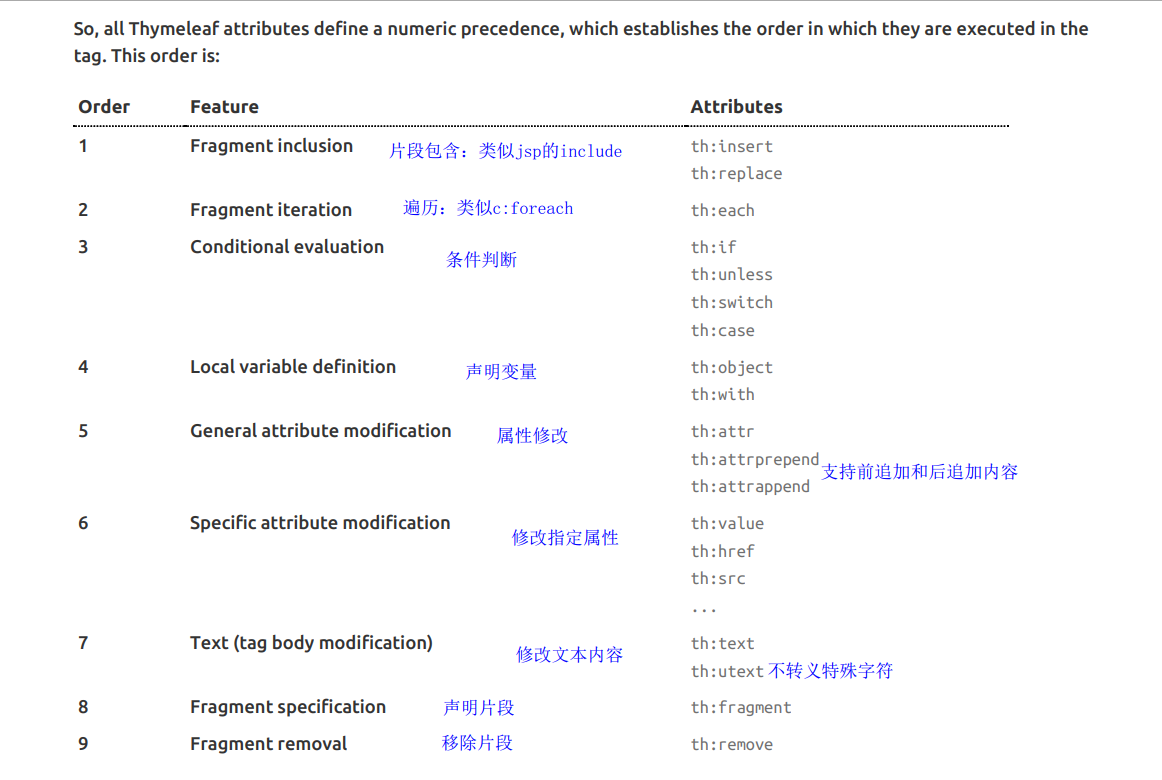
Standard Expressions
- Simple expressions:
- Variable Expressions: ${…}
- Selection Variable Expressions: *{…}
- Message Expressions: #{…}
- Link URL Expressions: @{…}
- Fragment Expressions: ~{…}
- Literals
- Text literals: ‘one text’ , ‘Another one!’ ,…
- Number literals: 0 , 34 , 3.0 , 12.3 ,…
- Boolean literals: true , false
- Null literal: null
- Literal tokens: one , sometext , main ,…
- Text operations:
- String concatenation: +
- Literal substitutions: |The name is ${name}|
- Arithmetic operations:
- Binary operators: + , - , * , / , %
- Minus sign (unary operator): -
- Boolean operations:
- Binary operators: and , or
- Boolean negation (unary operator): ! , not
- Comparisons and equality:
- Comparators: > , < , >= , <= ( gt , lt , ge , le )
- Equality operators: == , != ( eq , ne )
- Conditional operators:
- If-then: (if) ? (then)
- If-then-else: (if) ? (then) : (else)
- Default: (value) ?: (defaultvalue)
- Special tokens:
- No-Operation: _
Message Expressions: #{...}

    #ctx : the context object.
    #vars: the context variables.
    #locale : the context locale.
    #request : (only in Web Contexts) the HttpServletRequest object.
    #response : (only in Web Contexts) the HttpServletResponse object.
    #session : (only in Web Contexts) the HttpSession object.
    #servletContext : (only in Web Contexts) the ServletContext object
    #execInfo : information about the template being processed.
    #messages : methods for obtaining externalized messages inside variables expressions, in the same way as they
    		would be obtained using #{…} syntax.
    #uris : methods for escaping parts of URLs/URIs
    		Page 20 of 106#conversions : methods for executing the configured conversion service (if any).
    #dates : methods for java.util.Date objects: formatting, component extraction, etc.
    #calendars : analogous to #dates , but for java.util.Calendar objects.
    #numbers : methods for formatting numeric objects.
    #strings : methods for String objects: contains, startsWith, prepending/appending, etc.
    #objects : methods for objects in general.
    #bools : methods for boolean evaluation.
    #arrays : methods for arrays.
    #lists : methods for lists.
    #sets : methods for sets.
    #maps : methods for maps.
    #aggregates : methods for creating aggregates on arrays or collections.
    #ids : methods for dealing with id attributes that might be repeated (for example, as a result of an 					iteration).